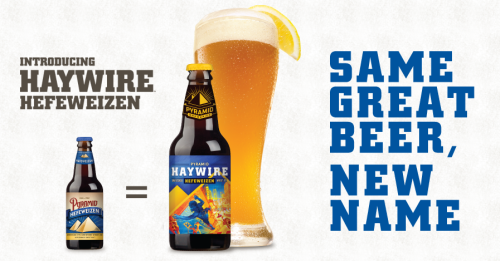
Pyramid has been going through some tough times recently. Remember they were bought out by Magic Hat last year. Recently they've rebranded all their beers. Which now seem weird and scary to me. Their iconic Pyramid Hefeweizen (the archtypical American Wheat Ale) is now 'Haywire Hefeweizen'. Because apparently that's MORE EXTREME!!!!!!!!
Friday, June 12, 2009
Pyramid Workers Arrested For After-Hours Fest
Pyramid has been going through some tough times recently. Remember they were bought out by Magic Hat last year. Recently they've rebranded all their beers. Which now seem weird and scary to me. Their iconic Pyramid Hefeweizen (the archtypical American Wheat Ale) is now 'Haywire Hefeweizen'. Because apparently that's MORE EXTREME!!!!!!!!
Thursday, June 11, 2009
New TTB Organic Wine Labeling Policies
But the sheet doesn't say how they are treating the wine adjuncts and additives. Is Isinglass organic? Bentonite? (Is it organic dirt?) What would an organic yeast look like? Oak barrels?
But it's back to the Bar Prep for me. Civ Pro, Crim Pro, and Trusts and Estates practice exam tonight. Good times.
Monday, May 4, 2009
Lake Chelan AVA Established / Paso Robles Westside AVA Expansion Revoked
Beginning May 29, 2009, the TTB will recognize another American Viticultural Area in Washington State. The new Lake Chelan AVA will cover 24,000 acres around Lake Chelan, and be nested within the current Columbia River AVA. Don't know much about its wine potential personally...the only time I've ever been to Lake Chelan was when we needed an abandoned desert area in which to film a Mad Max style car chase for a school movie project. No word on whether Thunderdome Chardonnay will be available anytime soon...
Secondly, the TTB has withdrawn its notice of proposed rulemaking for the creation of the Paso Robles Westside AVA in California. Without getting into it too much there appears to have been significant disagreements among Paso Robles' vineyards about both the name and geographic significance of the proposed AVA. The notice does give an excellent view into the sorts of commenting and considerations that go into establishing a new AVA.
Monday, March 2, 2009
2009 Brewers Association Style Guidelines Released
These guidelines are designed to assist brewers and brewing competitions (including the Oscars and the Emmys of the Beer World: the Great American Beer Festival and the World Beer Cup) in classifying and judging commercial beers, while also providing a sort of "State of the Union" concerning what styles are currently produced, which historical styles are being resurrected by craft brewers, and which are fading from production.
This year they added two new styles, bringing the total to 141. The two new styles are:
- American-Belgo Style Dark Ales - These dark beers portray the unique characters imparted by yeasts typically used in fruity and big Belgian-style ales.
- Session Beer - Ease of drinkability is a character in the overall balance of these beers. Beers in this category must not exceed 4.1% alcohol by weight (5.1% alcohol by volume).
I am actually quite happy with these two new styles. The American-Belgo styles the BA has added over the last couple years reflect the growing acceptance (and commercial success) of innovative American brewers who take the Belgian baselines and run with them. Russian River's Salvation Dark Ale, and other breweries like Lost Abbey, Jolly Pumpkin, New Belgium, Ommegang, Unibroue, and even relative newcomers to the Belgian game like Brooklyn Brewing come to mind. Nonetheless, the Belgian breweries (at least the non-Trappist ones) have never shied from creativity, and recent bottles have shown an similar effect happening in Belgium. For example, Houblon Chouffe was first brewed in 2006, and is a Belgian IPA-Tripel...Similarly, session beers are becoming a marketable style of their own. For example, Full Sail Brewing makes a beer called Session Lager, which is supposed to be an all-pilsner-malt pre-prohibition lager like your grandaddy used to drink. Interestingly, at 5.1% ABA it is on the far maximum of the style... "Lawnmower Beer" (so called because either you want one after mowing the lawn, or because they're low enough alcohol that you can drink them safely while mowing the law. Jury's out on that one.) has been a term in beer circles for a long time, and breweries are cashing in on the term. The best example I can think of is Saint Arnold Brewing's Fancy Lawnmower Beer. However, the original spirit of the term 'session' simply meant a beer you could drink a lot of for hours at a time and not pass-out and wake up half-dead. So this should include a wide variety of Cream Ales, Blondes, American and Mexican light lagers, and pretty much all the British Milds and Bitters. Does this category really define a 'separate' style?
There is also an interesting crossover to TTB labeling regulations here. As written about earlier, the TTB requires a Type/Class designation for all malt beverages. Generally these are: "Malt Beverage containing greater than 0.5% Alcohol by Volume". So most beer styles receive a type designation that has absolutely nothing to do with the actual style itself. I suggested that perhaps the TTB could look to things like the BA Beer Style Guidelines to refine these a bit and prevent larger breweries from watering down styles honed by smaller craft breweries, but that the costs of enforcement and potential stifling of new styles, creating a sort of onerous similarity to French wine appellation tasting panels, would outweigh any benefits. Still, it is interesting to compare the differences in how the industry defines the styles and the government.
Thursday, February 26, 2009
Snipes Mountain AVA
Been meaning to get to this since last week. The TTB has established a new American Viticultural Area (AVA) in the Snipes Mountain region of the Yakima Valley, Washington State, effective February 20th, 2009. The new AVA exists within the current Yakima Valley AVA, which in turn is within the greater Columbia Valley AVA. As you might expect, this nested AVA is quite small, at 4,145 acres it's the second smallest in the state according to Wine Press NW. But it is huge compared to the Cole Ranch AVA in Mendocino County, California, which is only 62 acres. Also, note that the new AVA incorporates Bridgman Cellars, makers of a particularly favorite Viognier of mine. (Image from WinesNW)AVAs exist so that winemakers from exceptional regions can denote that their wines are produced with a minimum of 85% grapes from that region. The requirements for establishing an AVA include local or national recognition of the name and boundaries, historical evidence of viticulural use within the area, and data on the special climate, elevation, soil , etc. of the region. For an interesting look at the process and requirements check out the Final Ruling on the Snipes Mountain AVA.
It's interesting to note that the Notice and Comment phase of the application brought in six comments, one of which brought up a potential problem involving a nearby wine region going by the name of "Snipes Canyon". The TTB responded to this:
"TTB believes ‘‘Snipes Mountain’’ is readily distinguishable from ‘‘Snipes Canyon.’’ Further, TTB is not aware of any conflict with existing brand labels that would occur if the viticultural area is established as proposed."Though it seems the TTB isn't worried about this, perhaps the wineries should be.
The AVAs in the Napa Valley region led to a host of litigation regarding the protection and use of the AVA in trademarks and COLAs. (See Bronco v. Jolly, 95 P.3d 422 (Cal. 2004); Bronco v. Jolly, 29 Cal.Rptr.3d 462 (Cal. Ct. App. 2005))
In Bronco, the Napa Valley Vintner's Association challenged Bronco's use of several Napa AVAs in its brand names "Napa Ridge", "Rutherford Vintners", and "Napa Creek Winery". These brands had been grandfathered in under 27 CFR §4.39(i)(2), but ran afoul of a California law prohibiting the use of an AVA name when the grapes originated elsewhere, in this case Lodi. 27 CFR §4.39(i) governs the prohibited uses of AVAs, and reads (emphasis provided):
(i) Geographic brand names.After a million dollars of litigation going up and down the California court system Bronco lost the use of its brands.
(1) Except as provided in subparagraph 2, a brand name of viticultural significance may not be used unless the wine meets the appellation of origin requirements for the geographic area named.
(2) For brand names used in existing certificates of label approval issued prior to July 7, 1986:
(i) The wine shall meet the appellation of origin requirements for the geographic area named; or
(ii) The wine shall be labeled with an appellation of origin in accordance with § 4.34(b) as to location and size of type of either:
(A) A county or a viticultural area, if the brand name bears the name of a geographic area smaller than a state, or;
(B) A state, county or a viticultural area, if the brand name bears a state name; or
(iii) The wine shall be labeled with some other statement which the appropriate ATF officer finds to be sufficient to dispel the impression that the geographic area suggested by the brand name is indicative of the origin of the wine.
(3) A name has viticultural significance when it is the name of a state or county (or the foreign equivalents), when approved as a viticultural area in part 9 of this chapter, or by a foreign government, or when found to have viticultural significance by the appropriate ATF officer.
Of course Bronco was a case where there was a specific California law prohibiting that sort of labeling and Bronco was making an enormous volume of wine with brands purchased specifically for their misleading names referencing a world famous AVA.
A quick search didn't turn up anyone using the actual brand "Snipes Canyon", though Brian Carter Cellars has a named Snipes Canyon vineyard. And of course any Snipes Canyon wines would still be entitled to use both the Yakima and Columbia Valley AVAs. So while it doesn't look like there will be a problem immediately, this is exactly the sort of situation that makes winery trademark lawyers nervous, so it's unlikely anyone will risk using the trademark.
Final note: there is a Snipes Mountain Brewery. Which raises the question of geographic labeling of beer all over again.
Monday, February 16, 2009
Obama labels
The TTB generally frowns on putting anything on a label that might make it look like the Government endorses it, or uses someone's name without permission. These prohibited practices are listed for all alcoholic beverages, for example 27 CFR 4.64 for wine, and 27 CFR 5.42 for distilled spirits.
So for example Section 6 of 27 CFR 5.42 reads in part (emphasis added):
(6) A trade or brand name that is the name of any living individual of public prominence, or existing private or public organization, or is a name that is in simulation or is an abbreviation thereof, or any graphic, pictorial, or emblematic representation of any such individual or organization, if the use of such name or representation is likely to falsely lead the consumer to believe that the product has been endorsed, made, or used by, or produced for, or under the supervision of, or in accordance with the specifications of, such individual or organization: Provided, That this paragraph shall not apply to the use of the name of any person engaged in business as a distiller, rectifier, blender, or other producer, or as an importer, wholesaler, retailer, bottler, or warehouseman, of distilled spirits, nor to the use by any person of a trade or brand name that is the name of any living individual of public prominence or existing private or public organization, provided such trade or brand name was used by him or his predecessors in interest prior to August 29, 1935.
(b) Miscellaneous. (1) Labels shall not be of such design as to resemble or simulate a stamp of the U.S. Government or any State or foreign government. Labels, other than stamps authorized or required by this or any other government, shall not state or indicate that the distilled spirits are distilled, blended, made, bottled, or sold under, or in accordance with, any municipal, State, Federal, or foreign authorization, law, or regulations, unless such statement is required or specifically authorized by Federal, State, municipal, or foreign law or regulations. []
"Fight Communism!" was ok though.
Of course, there's an American Flag and then there's an American Flag. Stoudt's Brewing Co's (amazing!) American Pale Ale COLA was approved in 1998. (That's 'Certificate of Label Approval', not Pale Ale Cola which just sounds unpleasant.)So while he was just a candidate, the use of Obama's name was iffy but so long as he didn't mind too much they let it slide. Now that he's the President they are really cracking down.
Of course, like the Stoudt's label there are dubiously legal (but apparently TTB approved) ways around this.For example, Pittsburgh's East End Brewing made this Belgian Tripel/IPA called "Ugly American".
Remind you of anyone?
Tuesday, December 16, 2008
New Alcohol Labels Under Obama Administration?
TTB proposes to amend its regulations to require a statement of alcohol content, expressed as a percentage of alcohol by volume, on all alcohol beverage products. This statement may appear on any label affixed to the container. TTB also proposes to require a Serving Facts panel on alcohol beverage labels, which would include a statement of calories, carbohydrates, fat, and protein. Industry members may also choose to disclose on the Serving Facts panel the number of U.S. fluid ounces of pure alcohol (ethyl alcohol) per serving as part of a statement that includes alcohol content expressed as a percentage of alcohol by volume. The proposed regulations would also specify new reference serving sizes for wine, distilled spirits, and malt beverages base on the amount of beverage customarily consumed as a single serving. However, TTB is not defining a standard drink in this document. We proposed to make these new requirements mandatory three years after the date of publication of a final rule on these matters. TTB proposes these amendments to ensure that alcohol beverage labels provide consumers with adequate information about the product.
(Image from this article at WSU.)
As you can see the alcohol %, serving size, and calories are displayed. This could cause trouble for some 'lite' beers, which typically still have around 100 calories and some carbs. Very interesting...
Also, though a cocktail might have more calories, it won't have a label when it's served to you. Could this hurt bottle sales? "OMiGod, did you know Miller Lite has 96 calories!?! I'm going to have a Cosmo..." (140 or so calories)
Finally, since the TTB is not defining a standard 'drink', could someone like Dogfish put a "Servings Per Container: 4" on one of their big beers, like World Wide Stout or 120 Minute IPA? After all, 120 Minute weighs in at 450 calories a bottle! (Not that we care...) Or could Miller Lite put that on and claim "Only 24 calories a (4oz) serving!"
More at Bevlog.
Monday, November 10, 2008
Geographical Indication of Beer?
Here's a post I've been meaning to write for a while. In mid-October Stan Heironymus' Appellation Beer reported that the Hallertau hop growing region was denied an Appellation of Control (AOC) by the EU. Notably, the EU has already granted AOC status to a different hop growing region, the Saaz area in the Czech Republic. I'll look for more details on the Hallertau situation, but a quick search hasn't brought up anything particularly useful. If it is true, however, it brings up a question I often think about:
Should beer be granted geographic designation like wine?
For wines geographic indication seems to be obvious enough, but in many ways beer appellation and, dare I say terroir, is much more complicated. What follows is a piece I wrote on the subject a couple months back.
There are certain regions that are well known for their beer. Some examples include Bavaria for German lagers and weisbiers, Belgium for abbey and wit biers, the Czech Republic for pilseners, and Burton-on-Trent for British bitters. These regions are famous due to a combination of location and history. Traditionally, the grains and hops would have to be produced locally, and water for the brewery came directly from the area. Styles developed around what sorts of recipes worked best with the particular combination of climate, ingredients and water. In this sense, these areas are very similar to famous wine growing regions. The locale impacts everything about the wine, and the most famous wines come from regions where the ingredients and climate come together perfectly. For this reason, many famous wine growing regions have been granted protected geographic indications to ensure that wines claiming that superior name actually come from that region. In the United States, a system of American Viticultural Areas (AVA) was established to protect the name of America’s best wine regions. So the question becomes, should beer be protected the same way?
Part of what makes a successful geographic indication is a good story about the history of the industry in the region. If a beer has been produced in the location for hundreds of years, it is more likely to be given a protected indication. However, America’s brewing history is very different from European brewing history. Many European styles were developed to suit their locale over several centuries. When European brewers immigrated to the United States, they did their best to adapt to local conditions, and regional American styles did develop.
However, with an influx of German immigrants in the later half of the 1800s, Pilsener became king. America’s most famous brewing regions were originally located in areas that had clean water and access to caves in order to lager the beer. Consequently, many of the mega breweries began in regions conducive to brewing this popular style: Coors in Golden, Colorado, Miller in Milwaukee, Wisconsin, and Anheuser-Busch in St. Louis, Missouri. Other regional brewers such as Pabst and Yuengling & Sons have much the same origin. In the late 1800’s the advent of refrigerated railcars and industrial scale brewing equipment made these beers available all across the country. No longer were beer consumers dependent on local ingredients and climate for their beer. Beer became an industrial product, available anywhere for the same price and with the same taste. However, there are signs that certain regions are once again becoming known for their craft brews. Does it make sense to grant these regions, some only a few decades old, a protected status? And is American beer an agricultural product, heavily dependant on location for its quality, or is it an industrial product, easily reproducible anywhere?
There are no equivalent protected geographic indications (PGI) or designations of origin (PDO) for beer in America. However, there are several in Europe, and a review of three important indications may shine some light on the potential pros and cons of a PGI for beer.1
First, many beer styles are named after the place they originated from. No beer exemplifies this better than Pilsener. The yellow lager that is now the most popular style in the world originated in the mid-1800s in the region of Plzeň and ÄŒeské BudÄ›jovice in the Czech Republic, thanks to new malting techniques and particularly soft water. The beers quickly gained popularity in Germany, under the German name Pilsener, and from there made their way to the United States. BudÄ›jovice is ‘Budweis’ in German, and from that came Anheuser-Busch’s iconic Budweiser, a name they have held a trademark in since at least 1876. In the 1890’s, BudÄ›jovický Budvar began selling Budweiser Budvar in Bohemia and the companies have been in litigation practically ever since. In 2005, Budweiser Budvar was granted a PGI by the European Union, further solidifying its position as “the” Budweiser.
This illustrates the potential trouble of PGIs in relationship to trademarks. The Czech Republic claims that the terms Budweiser and Bud are geographical indications and has successfully canceled Anheuser-Busch’s trademark registrations in several E.U. member states. Since most of the styles brewed in the U.S. either have a generic name, or source their semi-generic name to a European city, it is unlikely that conflict will arise within the U.S. The main problem breweries will face regards semi-generic trade names used for beers being exported to the E.U. and under TRIPS. However, in the future there could be domestic trouble as the styles develop. A brewer in New England might face litigation for brewing a “Northwest Pale Ale” or a brewer outside Alaska might brew an “Alaskan Amber”. Only time will tell if and where geographic indications crop up within the U.S.
Second, sometimes the specific requirements of a geographical indication backfire on a brewery. Newcastle Brown Ale was one of a small number of beers in Europe to hold a Protected Designation of Origin (PDO), which was dependant on the product being brewed in “the city of Newcastle upon Tyne”. The 1996 award was also granted on the basis that the brewing process used water “taken exclusively from the area” and included a yeast and salt/water blend “unique to the Tyne Brewery”. However, in August, 2005, Scottish and Newcastle, PLC, the ale’s owner, closed the Tyne Brewery and relocated two miles away to a larger facility on the other side of the river. However, the new location was technically outside the city of Newcastle and Newcastle Brown Ale became the first product in European Union history to apply for the revocation of its PDO status.2
Newcastle is important in two respects. First, it illustrates the problem of associating the brewery with a single geographic location. Breweries are buildings, not fields, and they are much easier to move. But even a move of only two miles could take the brewery outside of its PDO.
Second, Newcastle illustrates some of the considerations that might be taken into account in establishing a geographic indication. Note that the specific brewery yeast is mentioned. Many breweries use proprietary yeast, for example the British ale Boddingtons claims that it has used the same yeast for 200 years.3 The Danish brewery Carlsberg was the first to isolate lager yeast in 1883, naming it saccharomyces carlsbergensis, a strain from which most modern lager yeasts may well derive. More recently Rogue Brewing of Newport, Oregon, has bred and uses proprietary “Pacman yeast” and Samuel Adams has bred a “Ninja yeast” for their high-gravity beers. Similarly, the archetypical “American Ale” strain of the ale yeast saccharomyces cerevisiae is alternately called the “Chico Ale” strain, after the location of the Sierra Nevada brewery, which is credited with breeding it.
Similarly, the PDO for Newcastle mentioned the particular water/salt blend. Importantly, Newcastle was not being held to the water of the river Tyne, they were allowed to blend in salts to adjust the water to their needs. This effectively eliminates water as a geographically specific ingredient. Historically, brewers were dependant on their water supply. Hop acids react with particular salts in the brewing water, and harder water is more effective at extracting hop bitterness and flavor. This made the incredibly hard water of Burton-on-Trent famous for its British Bitters. Now however, a brewery may claim a PDO and yet “Burtonize” its water by adding gypsum, chalk and Epsom salts.
A final example of a known PGI for beer is Kölsch. These beers were originally brewed in and around the German city of Cologne, “Köln” in German, and currently carry a PGI in the E.U. However, the style is very popular among U.S. craft brewers as it is a lager-like beer brewed with an ale yeast, which allows smaller breweries to produce a light tasting beer without the extra expense and hassle of lagering. None of the beers could be called Kölsch in Germany, however, and the German brewers have been anxious for the U.S. to enforce their PGI. Geographical names are covered in the TTB class and type designations under 27 CFR § 7.24, provided in relevant part:
(f) Geographical names for distinctive types of malt beverages (other than names found under paragraph (g) of this section to have become generic) shall not be applied to malt beverages produced in any place other than the particular region indicated by the name unless (1) in direct conjunction with the name there appears the word "type" or the word "American", or some other statement indicating the true place of production in lettering substantially as conspicuous as such name, and (2) the malt beverages to which the name is applied conform to the type so designated. The following are examples of distinctive types of beer with geographical names that have not become generic; Dortmund, Dortmunder, Vienna, Wein, Weiner, Bavarian, Munich, Munchner, Salvator, Kulmbacher, Wurtzburger, Pilsen (Pilsener and Pilsner): Provided, That notwithstanding the foregoing provisions of this section, beer which is produced in the United States may be designated as "Pilsen," "Pilsener," or "Pilsner" without further modification, if it conforms to such type.
(g) Only such geographical names for distinctive types of malt beverages as the appropriate TTB officer finds have by usage and common knowledge lost their geographical significance to such an extent that they have become generic shall be deemed to have become generic, e.g., India Pale Ale.
(h) Except as provided in § 7.23(b), geographical names that are not names for distinctive types of malt beverages shall not be applied to malt beverages produced in any place other than the particular place or region indicated in the name.
Under these regulations it appears that the TTB is either considering Kölsch to be a generic, like India Pale Ale under 27 CFR § 7.24(g), or more likely it is allowing the use so long as the brewery specifies that it is an American product under 27 CFR § 7.24(f)(1).
Interestingly the U.S. does appear to have some protection of geographic origin in 27 CFR § 7.25, which reads:
(a) Domestic malt beverages.
(1) On labels of containers of domestic malt beverages there shall be stated the name of the bottler or packer and the place where bottled or packed. The bottler's or packer's principal place of business may be shown in lieu of the actual place where bottled or packed if the address shown is a location where bottling or packing operation takes place. The appropriate TTB officer may disapprove the listing of a principal place of business if its use would create a false or misleading impression as to the geographic origin of the beer. (emphasis added)
One has to wonder how Sam Adams Boston Lager, brewed all over the country, is not giving a false impression of its geographic origin. Nevertheless, there appears to be the rudiments of a geographic indication system already embedded in the TTB regulations. The question becomes, could the AVA system accommodate beer?
Beer is not wine, and the current AVA system may simply not work for beer. Interestingly, existing AVAs do overlap with some of the areas best known for their craft beer, including the Sonoma and Mendocino counties of California, various parts of Oregon, and the Puget Sound region of Washington State. However, these regions are more of a reflection of an intellectual terroir, a symbiosis of passionate brewers and dedicated consumers who make the atmosphere possible.
Drawing geographic boundaries around such an area would be pointless. Famous beer regions in the U.S. are famous because their beer is currently superior, not because it was made there since the Middle Ages. Also, a specific beer is not a product of the climate in the sense that grapes are. Certainly, these brewing areas may be close to hop growing regions, but it is the hops that are dependent on the sun and the soil, not the brewery.4 Perhaps hops should have an AVA?
In Europe, hops already have a protected designation of origin. Based on Regulation No. 503/2007 of the 8th May, 2007, the designation Žatecký Chmel (PDO) was registered in the List of Protected Designations of Origin and Protected Geographical Designations.5 The designation specifies certain areas known for hop production within the Czech Republic, and specifically applies to the famous Saaz variety of hop. Žatecký Chmel is the Czech name for the hop, which has been known since the early part of the last century by its German name “Saazer hopfen.” Saaz hops are considered to be some of the finest aroma hops in the world and are indispensable in many lagers, especially Bohemian Pilsners. Similar hop growing regions could likely apply for designation in the future, such as the areas around Hallertau and Tettenang in Germany, known for Hallertauer and Tettenanger hops respectively, and Kent in the U.K., known for the iconic East Kent Golding variety. All of these varieties are grown in other parts of Europe and the United States, but it is likely that use of a geographic designation will increase the price for producers of the real thing. Would this system work in the U.S.?
The Yakima Valley of Washington State grows 75 percent of America's hops and about 30 percent of the world supply.6 The Valley is also known for its wines, and was recognized in 1983 as the first AVA in Washington State. The appellation covers 600,000 acres of land that is bordered by the Rattlesnake Hills AVA to the north, the Horse Heaven Hills AVA to the south and the Red Mountain AVA, which forms part of its eastern boundary.7 Within the AVA two sub-appellations have been recognized, the Red Mountain AVA in 2001, and the Rattlesnake Hills AVA in 2006. The Yakima AVA is also entirely within the 11 million acre Columbia AVA.
The Yakima Valley seems to be perfect for a hop AVA. Hop growers recognize three distinct growing regions within the valley, the Moxee Valley, the Yakama Indian Reservation, and the Lower Yakima Valley.8 Each microclimate is conducive to particular kinds of hops, and could even be considered a sub-appellation. It is trade practice in the industry to specify certain hop varietals as “Yakima Magnum” or “Yakima Goldings”.
Everything is in place to specify the valley as a geographical indication except for one thing. If 75% of the hop crop is produced there, how special can Yakima hops be? And if the product is not special, why bother protecting it? Some craft brews specify the type of hops used, and some specify the area. Some consumers will place special value on certain varieties grown in certain regions, such as Saaz hops from the Czech Republic, but will consumers pay more for hops grown in the Moxee Valley sub-appellation than in the overall Yakima appellation? Hops are not grapes, and the bragging rights gained from an AVA will only carry the crop so far…
-----------------------------------------------------------------------------------------------------------
1 A list of current beer PGIs in the E.U. may be found at http://ec.europa.eu/
2 Publication, pursuant to Article 12 (2) of Council Regulation (EC) No 510/2006 on the protection of geographical indications and designations of origin for agricultural products and foodstuffs, concerning a cancellation application. 2006 O.J. (C 280)
3 Family owned until 1989, Boddingtons was acquired by the British brewer Whitbread, which in turn was acquired by InBev in 2000.
4 Of course, grains are also dependant on the sun but due to the centralized and industrial nature of the malting business it is often impossible to tell where the barley came from. Similarly, patent and trademark law already protects proprietary malting methods. A question does however remain about possible indication of traditional floor kilned malts such as Maris Otter malt, the basis for traditional British ales.
5 2006 O.J. C 204 (26.8.30)
6 Hop Growers of America, 2007 Preliminary Statistical Report, (2008), available at http://www.usahops.org/
7 27 CFR § 9.69
8 Hop Growers of America, Yakima Growing Region. http://www.usahops.org/index.
Wednesday, October 8, 2008
Does it Matter? (2)
Summary of the results (as of Oct 3):
Oh Fark... it's like the Argument Clinic sketch from Monty Python. Twentyfour-seven.
- 5, 264 votes were cast.
- 51% of voters replied that it did not matter who made the beer they bought.
- 49% of voters replied that it did matter to a significant extent who made the beer they bought.
- 150+ comments were submitted to Fark.com.
But Charlie puts the problem well:
Americans enjoy the best choice of beers available anywhere in the world. It’s my opinion that in this day and age of company consolidation, big box retailers, large grocers and ever growing large brewing companies, the diversity and choice beer drinkers enjoy today – is a becoming a very very fragile situation.Could he be laying the groundwork for a push for increased specificity in labeling? If so, with Pete's Brewing v. Whitehead to contend with he is definitely moving in the right direction.
It’s hard to explain this to the average beer drinker. Here’s one point that’s worth making: Access to market remains a difficult proposition for small and independent brewers. Large brewers through their distributors dominate the decisions determining which beer brands get shelf space and how much shelf space they get. Distributors also significantly influence restaurateurs and the choices they make about what beer is served on the limited number of draft beer tap handles.
To the beer drinker it may seem logical that availability of a particular beer brand is based on consumer demand or profitability. But this is often not the case. Many beers receive shelf space or are delegated a tap handle because of the financial muscle a company can apply to force a decision upon the seller. Small and independent American brewers are often denied access to market due to these dynamics; regardless of consumer demand.
Monday, October 6, 2008
Monday Morning Roundup

1) Playboy Wine
First up, Playboy has entered the wine game. Looks like they're paired with the wine.com guys and offering a wine a month. Soon everyone will have their own label wine... The first four are Cab Sav, from reputable vineyards as well. They range from $90 to $380, and apparently you will be able to buy all 12 for $1500 in September.
What's interesting about this is how hard they must have worked to get their labels approved. You can just see the label approval agent, "Playboy wine? Where'd I put my 'DENIED' stamp?" Pretty much every liquor board and the TTB have restrictions on lewd labeling, either by statute or practice. Obviously none of these labels are particularly scandalous, looks like they used 1960's centerfolds.
Just like Friday the 13th Part 1: pretty tame by today's standards...
2) News from England
Interesting articles on the BBC. First is about the relative plight of teetotalling college students at British universities. Interesting considering the U.K.'s growing problem with underage drinking and youth alcoholism. Second is that the UK has rejected calls to lower the drink-drive limit from 80 mg/100 ml to 50mg. That limit would have been about half a pint of beer.
3) Wine Spectator: Mobile
Wine Spectator has announced a new service specifically designed for use in PDAs, allowing you to look up wines and check ratings on the go. You know, so you can be that guy.
4) French fear worst wine sales since 9/11
Wine seems to be taking a hit, at least imports, but what about beer? I've been wondering: is beer recession-proof? Maybe I'll write more about it later, but for now here' s an article from the Washington Post.
5) How can it be the original source Pilsner if it's from Russia?
Article from the Prague Monitor about Pilsner Urquell being brewed in Poland and Russia. The author, Evan Rail, takes issue with a beer that literally translates as Pilsner Original Source being brewed in Russia and Poland. It gets to the heart of a problem faced by traditional beers: are they a style, or are they a place? Guinness, for example, is associated with Dublin. It's brewed there as well. But it's also brewed in regional breweries all over the world. So it's more of a brand. But take Newcastle Brown Ale. It had to relinquish it's PDO (Protected Designation of Origin) status in the E.U. after moving its brewery across the river Tyne, just outside the boundaries of the city of Newcastle. So you've got place.
Where does Pilsner Urquell stand? I lean toward brand, because it's associated the world over with being the "original" pilsner. It's the original source alright. But then, I'm not Czech, and the Czechs are very attached to their national pivo. After all, they staked out the first PDO for hops, Zatecky Chmel (Saaz hops) and several of their beers (Budweis) carry PDO status. So maybe pride has something to do with it too.
Of course, to be have the type/class designation of Pilsner in the U.S. it has to be be brewed in either the U.S. or the Czech Republic. Everything else 'must include the word “type” or “French” or other adjective or statement, e.g., “Brewed in France,” indicating the true place of production'. I don't think the Russian and Polish Pilsner Urquells are destined for the United States, but it would be interesting if they had to be labelled Pilsner Urquell - Brewed in Russia.
Tuesday, September 30, 2008
Does Ownership Matter? Pete’s Brewing, Beer Labelling and Trade Names
Charlie Papazian, President of the Brewer's Association, asked that question in last Thursday's AHA TechTalk newsgroup. It gets to the heart of a problem I've been thinking about, one that gets to the heart about how people feel about beer, and the responses from the homebrewers have been varied and interesting.
The email is below:
----------------My response is that it obviously is going to matter to some, so the real question is how much does that count for? People buy a beer or wine for a variety of reasons: price, style, year, geography, location on the shelf, nostalgia, habit, image, or simply that they like the yellow kangaroo on the bottle. Some people harbor grudges against large breweries, either because of taste, or image, a preference for local over global, or simply because it's hip to fight The Man. Some people take issue with the advertising, practices, or politics of certain companies and will not purchase from them for ethical reasons. Point is, people will buy or not based on many factors and I believe they should be given enough information to make an informed decision should they wish to.
From: Charlie Papazian
Sent: Thursday, September 25, 2008 12:03 PM
Subject: Does It Matter?
I think there is an ongoing debate about whether beer drinkers really care about where their beer comes from. Does it really matter that Blue Moon is made by MillerCoors? Does it matter that Pilsner Urquell is made by SABMiller? Does it matter that German brewed Becks and Diebels Altbier, Belgian brewed Hoegarden and Leffe, English brewed Bass and Boddington, Australian brewed Castlemaine XXXX, Irish Murphy's and Canadian Labatt, and likely soon Budweiser are all under the ownership of the Belgian/Brazilian world brewing corporation Inbev?
We are all beer drinkers. That said, we all have our reasons for choosing the beer we love to enjoy. Whether we realize it or not, we all think about it in one way or another. At the very least we owe it to ourselves to be knowledgeable about the beer we spend good money for. I’m wondering whether these things matter to American Homebrewers Association membership.
What's Next? The Great American Beer Festival - October 9-11, Denver, Colorado
See my page at www.Examiner.com
Charlie Papazian
President
------------
If they want to buy the one with the kitty on it then they are free to do that too.
I personally want as much information as possible about any beer I am considering buying. However, the brewing industry makes extensive use of trade names so it is often difficult or impossible to tell who owns a particlular beer simply from the label. Case in point, and I admit a personal peeve of mine, AB's Stone Mill Organic Pale Ale. The labels don't show Anheuser's name anywhere. The brewery is identified as Green Valley Brewing, Merrimack, NH. Of course, Merrimack, NH is home to one of AB's regional breweries and is indeed where Stone Mill is brewed.

Part of the problem here is that craft brews have built a reputation for quality and creativity, based on small production runs and more expensive ingredients and practices. To a first time purchaser however, the only indication of future quality comes from the bottle's label. If the label has a 'micro' look to it, it will be assumed that the all the expectations one has about what goes into making a craft brew will be in the final product. Not that it was made in a 100,000 barrel system, with non-organic hops, and is loaded with rice. The craft brew industry gets by on the quality of its product, and the image of small brewers, working in small batches, making what they like to make. If that image is appropriated through misleading labels and marketing, consumers are suckered and the small brewers lose their competitive advantages.
Note that the taste or quality of the faux-micro is irrelevant to this. It could be a great beer, but it's still using an image it didn't earn and doesn't deserve. Look at the Stone Mill label again, and think about what that label implies. There's a quaint stone mill, a running fresh stream, lots of foliage. The real Merrimack plant is an enormous industrial park. This is not to say it should be required to have the plant pictured on it, but only that when a company makes a claim about small batches or traditional preparation, it back it up. For example, on French wine labels you cannot use the picture of a chateau that isn't actually on the land where the vineyard is.
Speaking of wine, this problem exists in the wine industry as well. Every winery wants to sell its "story". Typically it runs something like this: a family winery that makes wine because they love it, and want to make the best small batches of wine they can, in the best traditions of the Old World. It could be argued that by purchasing a wine you are "buying into" this "wine story", so that when you drink the bottle you imagine that pastoral setting and appreciate the individual care given to that wine over its lifetime. This is all part of the experience, and probably makes drinking the wine that much more pleasurable. The fact is there are actually wineries like this, and they are understandably perturbed when a producer markets its 500,000 case wine as 'So-and-So Family Winery', with a label that typically has a quaint old farmhouse or chateau of some sort.
One possible solution would be to require that the name of the brewer who bottles and packages the beer be on the label and in advertising, and to provide that a trade name or fictitious name may not be used to replace the name of the brewer on labels and in advertising. So for example So-and-So Family Winery would be required to have its owner, Omni-Corp Int'l., on the back label.
This was tried a decade ago on the state and federal levels and was ultimately unsuccessful. However, the failure is itself instructive and lends some perspective on how labeling might work.
PETE'S BREWING
In early 1996 Anheuser-Busch lobbied the Missouri state legislature to pass a bill requiring labels to state the true owners of the facility where beer was produced. The Missouri Legislature subsequently passed Senate Bill 933 which was codified as Missouri Revised Statute § 311.360.2. (Supp.1998). Section 311.360.2 provided:
Any malt liquor which is offered for sale in this state and manufactured at other than a facility owned by the person whose name appears on the label of the container shall include on the label the name and location of the owner of the facility which produced and packaged the malt liquor. This subsection shall become effective January 1, 1997.In order to further clarify the terms “owner” and “facility” the Supervisor of the Missouri Department of Liquor Control filed an emergency amendment and permanent amendment to 11 CSR 70-2.060, which stated:
[I]f the name of the brewer or manufacturer of malt liquor which appears on the label is not the owner of the facility where the malt liquor was brewed or manufactured, then the name, owner and address of the facility shall also be set forth on the label.“Owner” was defined for purposes of the regulation as:
(7)(B) An “owner” of a facility which brews or manufactures malt liquor is defined as a person, corporation, limited liability corporation, partnership or other legal business entity, who holds the entire facility in fee simple, or has a leasehold interest for a term of years in that entire facility, and is the person or business entity licensed for that entire facility by either or both, the state within which the facility is located and/or the United States Federal Alcohol Administration.These regulations specifically addressed contract brewing and trade name usage in the brewing industry. Any beer brewed for another brewing company under contract would be forced to disclose the facility where the beer was brewed, while breweries using trade names would be forced to disclose the parent company that owned the brand. For example, Pete's Wicked Ale which was made by Pete's Brewing Co., but was brewed at a facility owned by Stroh's, would have to place Stroh's name on its label. Regarding trade names, Miller (not yet Miller Coors) would have had to place the name Miller on its Plank Road products Red Dog and Icehouse.
At the same time, Anheuser-Busch and a consortium of regional microbrewers petitioned the Bureau of Alcohol, Tobacco and Firearms (BATF) to initiate a rulemaking proceeding seeking a similar change on a federal level.2 Signing onto the petition along with Anheuser were Widmer Brothers Brewing Company, of Portland, OR; Hart Brewing Inc., of Seattle; Full Sail Brewing Company of Hood River, OR; Redhook Ale Brewing Co., of Seattle, and the Oregon Brewers Guild, of Portland. Interestingly, each of these breweries was at the time a regional microbrewery, similar in scale to Pete’s Brewing and Sam Adams, though each of these breweries actually owned their own facilities. The Oregon Brewer’s Guild represented the interests of many smaller Oregon Breweries, which often did not distribute outside of the state.
The reasons cited for this rulemaking were, outwardly, well-intentioned. "This is a dollar and cents issue for American beer drinkers," said Paul S. Shipman, president of Redhook. "Consumers are being misled. They are literally buying into an image ... paying higher prices for some brands without really knowing who actually brews their beer. Beer drinkers should get all the information they need to make informed choices."4 The request cited claims by Sam Adams and Pete’s that their beers were "brewed in small batches with only honest ingredients" and Sam Adam’s invitation "to visit us at our small traditional brewery ..." Regardless of whether or not these claims amounted to mere puffery, at least a prima facie argument could be made that consumers were being misled.
Meanwhile, in Missouri the Department of Liquor Control began trying to enforce Section 311.360.2. Trouble began in November, 1996, when the state notified Pete’s and Miller that some of their labels might not be in compliance. This was the first notice these companies received, even though enforcement of this statute was scheduled to begin in twenty-one days. Rather than submit new labels they filed a federal lawsuit seeking an injunction from enforcement of Section 311.360.2.5
While the lawsuit in Missouri was progressing, the attempt at the federal level was failing as well. Though outwardly calling itself a consumer protection measure, the petition was beginning to look more like an attempt by Anheuser-Busch to stifle competition. Consequently, in May, 1997, the Oregon Brewers Guild (OBG) sent a letter to the BATF withdrawing their support for the petition. Mike Sherwood, Executive Director of the OBG stated that "The Guild's primary function is to promote craft brewing in Oregon. It appears that our goals of promoting truth in labeling may be in conflict with Anheuser-Busch's intent with this petition.” Gary Fish, founder of Deschutes Brewing Co. and President of the OBG said, "The petition has been used to create acrimony and disharmony in the craft brewing industry. This was never the intent of the Guild. The Oregon Brewers Guild will continue to promote the voluntary listing of the 'brewery of origin' on the label by all breweries."6
In its opinion issued September 10, 1998, the court in Pete’s Brewing agreed with the Plaintiff breweries’ contention that § 311.360.2 violated the Dormant Commerce Clause.7 Citing SDDS, Inc. v. South Dakota, the court noted that a state law may discriminate against interstate commerce on its face, in its purpose, or in its effect.8 Even if a state law does not overtly discriminate against interstate commerce, it may nonetheless be contrary to the Commerce Clause if it unduly burdens interstate commerce.9 Non-discriminatory state laws, however, are subject to a less rigorous balancing test. The court cited Pike v. Bruce Church, Inc., arguing that such a law “will be upheld unless the burden imposed on ... commerce is clearly excessive in relation to the putative local benefits.”10
With the analysis laid out, the court set out to prove discriminatory effect, purpose and/or intent. The court relied heavily on Hunt v. Washington Apple Adver. Comm., (a statute has a discriminatory effect if it raises the cost of doing business for out-of-state producers but does not raise the cost for in-state producers) and Exxon Corp. v. Governor of Maryland, (statutes which “raised the cost of doing business for out-of-state dealers, and, in various other ways, favor[ ] the in-state dealer in the local market” have a discriminatory effect.)11
The statute’s impact on out of state brewers was clear. There was no evidence to suggest that a single Missouri brewer would have to change its labels. The three biggest brewers in Missouri, which accounted for 99.8% of the Missouri-brewed beer sold in the state, would not have to change their labels.
The court analogized this to the situation in Hunt. In Hunt, Washington State apple growers were being forced to change the label on boxes of apples sent to North Carolina. The apple producers were left with three choices: “obliterate” the prohibited writing on their old labels, develop labels only for use in North Carolina, or change all of their labels to accommodate North Carolina's law. The court argued that beer producers and importers in this case were faced with almost identical considerations and burdens. Brewers could develop Missouri only labels, resulting in higher costs. They could change all of their labels to meet the Missouri statute, which, the court stated, might lead to market confusion and competitive disadvantages in other states. Finally, they could simply stop selling their products in Missouri.
Quite apart from the increased cost of doing business, the court noted that the statute would also deprive out-of-state producers and importers of marketing advantages. The court cited Hunt, noting that in that case, the statute was unconstitutional in part because it stripped the Washington apple growers of the economic advantages they had established through their own grading system.12 In Pete’s Brewing, the statute stripped Plaintiffs of the brand equity they had built up through advertising and trade names. The opinion argued:
The public may associate a brewery owner's name with completely different product qualities of brand identity than the brewer. This compromises the effectiveness of competitive strategies which the Plaintiffs feel best meet their business needs. These competitive strategies include the use of trade names to create distinctive brands and broaden the product's appeal, and the use of other companies' factories to avoid the expense of buying or building a brewery. Though legal in every state, Missouri brewers do not employ these competitive strategies and they would benefit if other out-of-state brewers were prevented from being able to use them.13The court found that both the increased costs to out-of-state brewers and their potential loss of brand equity were sufficiently of the type of burden found unconstitutional in Hunt.14
The court next looked to whether the in-state brewers were benefited by the statute. Here the overbearing manner in which Anheuser-Busch had pushed for the law was used against it. Apart from the competitive advantages mentioned above, the court took Anheuser’s aggressive support for the bill as evidence that it derived a benefit from the statute. In a particularly damning piece of evidence, Anheuser’s goal of removing its rivals was made perfectly clear to the court.15 The court looked not just at the discriminatory effect of the statute but considered evidence of discriminatory purpose. Testimony by administrators and the legislative history of the bill clearly showed that the statute was a product of Anheuser-Busch’s lobbying. There was no evidence that consumers had been complaining, or that the statute advanced a legitimate state interest. The court subjected the statute to strict scrutiny and it was summarily found to be an unconstitutional violation of the dormant commerce clause.16 Alternatively, the Court found that § 311.360.2 failed even the more flexible balancing test set forth in Pike.17
The Defendants argued that the statute could be saved by § 2 of the Twenty-first Amendment.18 The Supreme Court has recognized that the Twenty-first Amendment provides an exception to the limitations of the dormant Commerce Clause in certain situations. The court relied heavily on the “balancing” aspects of Brown-Forman Distillers Corp. v. New York State Liquor Authority and Bacchus Imports, Ltd. v. Dias in its analysis of the aims of the statute versus its impact on interstate commerce.19 Ultimately it decided that the statute did not adequately support any of the core temperance goals of the 21st Amendment.20 The injunction was issued and statute was not enforced. After Pete’s Brewing, the petition for rulemaking to the BATF died as well.
At first glance, it would seem that Pete’s Brewing forecloses the entire idea of requiring labels to state the actual brewing facility. However, the context in which this law came to the court must be taken into account. Based on the patently obvious way that § 311.360.2 was a product of Anheuser-Busch lobbyists, and on its near exclusive benefit to the largest brewery in the country, the court was understandably suspicious. The success or failure of any such regulation is entirely dependent on the reasons proffered for its existence and the evidence used to support its effectiveness. In Pete’s Brewing there was simply no reason offered that could dispel the impression that the statute was passed solely to benefit Anheuser-Busch.
However, in the case of interested craft brew consumers, Pete’s Brewing is essentially inverted. Instead of the largest brewery fighting its next two rivals, it is a case of smaller brewers and consumers against the Big Three. Ten years ago, Anheuser didn’t have any faux-craft brews, and now it has several. Meanwhile the industry has continued to grow, and the base of educated consumers has grown. In many states, there are no remaining major breweries, but there is a thriving craft brew industry. A well lobbied campaign, run by consumers and small brewers could address many of the reasons Pete’s Brewing came out the way it did. Studies and rallies conducted by a consumer group could be used to support a claim of legitimate public interest.21 Intrastate regulation would be an easy way to begin, as a state would be well within its power to require in-state brewers to provide detailed labels.
If a state was legitimately interested in more extensive origin labeling, it would have to emphasize the public interest served by informing consumers. They would have to provide evidence that the cost of redesigning labels was minimal. The statute should be worded such that the name brewery or trade name is on the bottle as well as the production brewery, in order to lessen the impact on the brand equity of the trademark. For example, trade names could be allowed on the front label, but the back label must specify the actual brewing company as well. This would let interested consumers inquire while minimally impacting the presentation to uninterested consumers.
Finally, this suggested regulation is, of course, just that: a suggestion. The practical complexities of the brewing industry, the lobbying power of the major breweries, the fractious nature of the craft brewing industry, and the byzantine complexities of United States alcohol law all might well prevent such a regulation from ever happening. However, this analysis suggests that were there to be a will, there would be a way.
-----------------------------
1 It is interesting to note that, at the time of this litigation, Pete’s Brewing did not in fact have any facilities of its own, a fact used proudly in its investment prospectus. Similarly, Sam Adams retained its original Boston brewery, but due to volume limitations had ceased to brew all but its experimental and premium beers there. The brewery’s flagship Sam Adams Boston Lager, distributed throughout the US, was contract brewed in various locations around the country.
2 Letter from Patrick T. Stokes, President, Anheuser-Busch, Inc., et all, to Brad Buckles, Deputy Director, BATF, Re: Truth in Beer Labeling/Petition for Rulemaking (Jan. 25, 1996) available at http://www.thefreelibrary.com/
3 To give an idea of how complex these ownership problems can become, of these original regional breweries: Redhook purchased Widmer in 2007, though Anheuser-Busch retained its prior minority interest in both companies and its exclusive distribution agreement; Hart Brewing became Pyramid Brewing and was purchased by Vermont-based Magic Hat Brewing in 2008; Full Sail actually became employee-owned in 1999, but does contract brew for SABMiller under the 150 year old Henry Weinhard’s label, which Miller acquired from Stroh’s in 1999.
4 Brewers Seek New Federal Rules, BUSINESS WIRE, Jan. 25, 1996, available at http://www.thefreelibrary.com/
5 Pete's Brewing Co. v. Whitehead, 19 F. Supp. 2d 1004 (W.D.Mo., 1998).
6 OBG WITHDRAWS BATF PETITION, BEERWeek, May 12 - 19, 1997.
7 U.S. Const. Art. 1, § 8, cl. 3
8 SDDS, Inc. v. South Dakota, 47 F.3d 263, 267 (1995).
9 Id. 47 F.3d at 268.
10 Pike v. Bruce Church, Inc., 397 U.S. 137, 142 (1970).
11 Hunt v. Washington Apple Adver. Comm., 432 U.S. 333, 352 (1977). Exxon Corp. v. Governor of Maryland, 437 U.S. 117, 126 (1978).
12 Hunt, 432 U.S. at 351-52
13 Pete’s Brewing at 1012.
14 Id. at 1014.
15 “On November 17, 1997, A-B sent a letter to all Missouri wholesalers. The letter highlighted the fact that the Missouri Supreme Court had just upheld § 311.360.2 and went on to state: In other words, retailers will also be in violation of this law if they sell any non-complying products. There is a possibility that this will create a shelf-space opportunity for us as some of these products are eliminated from the Missouri package mix. In particular, you should target the following brands if their labels are not changed: Samuel Adams, Pete's Wicked Ale, Red Dog, Icehouse, Blue Moon. Please cover this topic with your sales force during upcoming sales meetings and take advantage of any opportunities as a result of competitive brand fallout in the market place.(Ex. 315).” Id. at 1014, FN9.
16 Id. at 1017.
17 Pike at 142.
18 Section 2 states “The transportation or importation into any State, Territory, or possession of the United States for delivery or use therein of intoxicating liquors, in violation of the laws thereof, is hereby prohibited.” U.S. Const., Amdt. 21, § 2.
19 Brown-Forman Distillers Corp. v. New York State Liquor Authority, 476 U.S. 573 (1986). Bacchus Imports, Ltd. v. Dias, 468 U.S. 263 (1984).
20 The Court must inquire “whether the interests implicated by a state regulation are so closely related to the powers reserved by the Twenty-first Amendment that the regulation may prevail, notwithstanding that its requirements directly conflict with express [federal] policies.” Bacchus at 275-76.
21 Perhaps along the lines of the United Kingdom’s Campaign for Real Ale (CAMRA) http://www.camra.org.uk/